|
Catching Light Photography by Dan Lessmann |
Oklahoma City Clear Sky Clock
Cheddar Ranch Observatory Clear Sky Clock |








|
|
|
|
|
|
Catching Light Photography by Dan Lessmann |
Oklahoma City Clear Sky Clock
Cheddar Ranch Observatory Clear Sky Clock |
|
"I eagerly await the new concepts and processes. I believe the electronic image will be the next major advance." --Ansel Adams, from the introduction to his book "The Negative", March 1981
I don't believe Ansel knew just how right he was...
...but I started in the film days. My first SLR was a Pentax K1000 purchased in the mid-seventies. I loved that camera and happily stayed with the Pentax line throughout my film days with my last film SLR being a Pentax ME. Sadly, the K1000 was stolen along with my lenses (sniff). Knowing what I know now, I regret not switching over to Canon at that time as it turns out that I've fallen in love with the Canon digitals. All that Pentax equipment sits in a pantry and hasn't been used in quite some time. Yet I can't seem to part with my old lenses or the ME!
All of my photographic work is now digital. There are some things about film that I miss but I very quickly came to appreciate the "virtual darkroom" aspect of digital photography and the freedom of shooting many, many shots with no concerns about the cost of film development.
There is of course a learning curve involved with both the software and the equipment and this is in fact a curve I'm still on. I believe this is never ending. Once cameras went digital and we adopted them, we basically entered into the frenetic world of computers and other high tech equipment and software. That means we're always behind the technology curve, our equipment is obsolete the day we buy it and there's always something new to learn. No matter. It all still works and I actually like the constantly changing aspect of the digital world.
Astronomical Telescopes and Associated Equipment
|
|
|
|
|
|
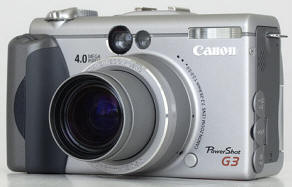
Canon PowerShot G3
This camera marks my entry into the digital world. This is of course not an SLR but what the industry is now calling a "creative compact" camera which makes it a bit limited. But at the time, there were not many consumer digital SLRs available and the least expensive was about $3K for the body only.
Regardless, the G3 has a lot of nice features and its small size makes it convenient to take anywhere for anything. It usually stays in my car for the chance shot opportunity; something I would not do with my DSLR or lenses.
The automatic exposure methods are good and there's enough manual control to handle most situations. Its 4 mega pixel resolution, while now considered somewhat coarse, is plenty for most situations. Many of the daylight photography shots on this site were shot with this camera and I often find myself scaling down the higher resolution images captured by my other cameras.
The one thing really missing... No bulb setting for long exposures but this is typical of point-and-shoot cameras. The maximum exposure available with this camera is 15 seconds. That's long enough to do some minimal long exposure work but unlimited exposure, or at least 30 seconds would be nice. Even so, I like this camera and still use it often despite having added DSLRs to the equipment kit. |
|
|
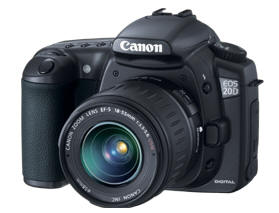
Canon EOS 20D
I had my eye on the Rebel but the 8 mega pixel resolution of the 20D (versus 6 for the Reb) and USB 2 compatibility was too much to resist. I also prefer the metal body over the Rebel's plastic one. So far I've been very pleased with this camera. It feels solid and substantial when shooting and the controls are easily accessible.
The 18-55mm kit lens is not a bad match for the camera for most uses. That's the equivalent of about a 28-88mm telephoto with the APS-C chip size (1.6 crop factor) in the 20D making a nice general use lens albeit a bit short on the long end.
I've seen many less than complimentary reviews of this lens but I've had no problems with it. The only thing I don't like is that there is no indexing on the focus ring when manually focusing. This is not a problem with daylight work but is a problem when shooting wide field astro work where one needs to manually set the lens to infinity. There are certainly better lenses available for an all around use type lens but this one's not bad at all and is inexpensive enough to replace that I wouldn't feel all that bad if I dropped it in a lake or something.
On the downside for the camera, I find the camera's built in flash to be a bit weak and its close proximity to the lens sometimes causes some shadows at wider angles. It's okay for some applications but is a bit limited. For that reason, I've added the Speedlite 430EX flash gun to my kit and also included an off-camera shoe cord for a bit more versatility.
I'm also a little concerned about purchasing a bunch of true EF-S lenses since they won't fit on full frame digitals now available and no doubt in my future somewhere. I'm keeping EF-S lens purchases to a minimum while these issues sort themselves out just in case I choose to upgrade later. My hope is that the EF-S lens mount will somewhat fade away.
I use this camera for both daylight and astronomical work. |
|
|
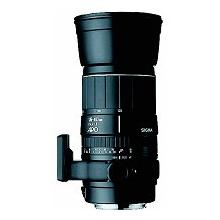
Sigma 135-400, f/4.5-5.6 APO Telephoto
This lens is the equivalent of about a 216-640 telephoto for a full 35mm frame. I acquired it primarily for long-lens daylight photography although I've shot some astro work with it as well. It's not really fast enough for good astro work and prime lenses are a better fit for astrophotography.
This lens has some great features. It comes in a nice case with a lens hood and tripod mounting ring. The ring allows for quick change of the frame from landscape to portrait while still keeping the lens and camera secure and holds the lens and body when clutched tight with good balance on a tripod for all zooms. For daylight work the lens is nice and sharp from edge to edge and the APO design works well with little to no color fringing.
On the downside, a few aberrations show up in astro work with a bit of softness and coma in the corners when the lens is wide open. Stopping the lens down a couple of notches helps with this but the lens is quite slow already so that's not really desirable. It's also quite heavy at 43oz. and the telescoping zoom gets a bit long at high powers.
I would also prefer that the zoom ring be a bit tighter. I've had it slip on its own when pointing the lens up or down at extreme angles.
Since it's not image stabilized, it most definitely requires a tripod or monopod although I've shot some handheld frames at 135mm successfully. I've also found the USM auto-focusing to be a bit problematic in low light or low contrast shots. I find myself switching to manual focusing quite a bit. This plus the lack of stabilization makes this lens a poor choice for fast action shots.
This is not an "L" series lens and, knowing what I know now, I might spend a bit more for another long lens option. But I still believe it is a good value for the price and it will stay in my kit for now. |
|
|
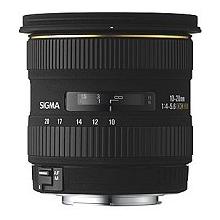
Sigma 10-20, f/4-5.6 DC EX HSM Telephoto
This is a brand new lens for me as of this writing but my first impression is WOW! The finish on this lens is a nice black matte and the focus and telephoto rings are nice and tight with good tactile feel. It sits well in the left hand when shooting. For the 20D chip, this lens has the equivalent field of view of about a 16-32mm wide angle zoom. This lens seems to me to be a cut above the 135-400 telephoto in build quality.
The HSM focusing appears to be much superior to the USM focusing. Certainly it's quieter and it's very fast and accurate. I have no complaints at all regarding auto focusing with this lens including in low light conditions. The lens also includes manual override focusing. Other nice features are the included petal lens hood and case.
Downsides... It's a bit slow at f/4 but that's okay for daylight work which is my intended use. It's also designed specifically for cameras with APS chips and will vignette a full frame chip. So even though it's not an EF-S mount, it's still realistically limited to cameras with APS size chips. |
|
|
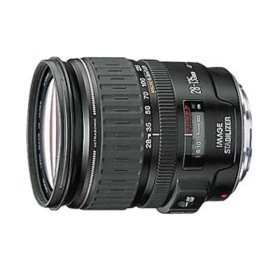
Canon 28-135mm f/3.5-5.6 IS USM Telephoto
Equivalent FOV of a 45-216mm telephoto with the 1.6 crop factor of an APS-C chip, I bought this lens to fill a focal length hole in my kit from 55 through 135mm. This lens has since become my preferred general use lens although I find from time to time the need to switch over to the Sigma 10-20 wide angle for shorter focal lengths. With a full frame camera, this lens would offer a pretty much perfect range of focal lengths for a general use lens.
Reviews of this lens are mixed. Me, I've been pleased with the lens for daylight work and believe their must be a few lemons out there or some of the reviewers are expecting "L" series performance from this lens. It is not an "L" lens but I didn't expect it to be.
The nice range of focal lengths especially when the full kit is left back at the house is its best feature. I've found the 20D, this lens and the Sigma 10-20 make a great grab and go kit that handles most situations very nicely indeed.
The auto focus is nice and snappy even in low light, low contrast conditions and is very quiet. This lens also provides full time manual focusing; a feature I've come to really appreciate through use of the Sigma 10-20. Being able to get creative with focus with no need to switch between manual and auto focus is a great feature.
The image stabilization is great at all focal lengths but I have found that it's best to turn off IS when the camera is on sticks. This is recommended in the instructions and of course stabilization is not required on a tripod.
To be fair though, there are some downsides. The biggest I've encountered so far is the weight. There's a lot of glass in there with 16 elements necessary for the focal length range this lens provides and this pushes the weight up a bit. It's also quite a bit larger both in diameter and length than the kit lens making the camera with lens a bit bulky for a carry around all day rig. But that's quite a bit less bulk than would be the case if a second longer lens had to be carried.
The lens is also a bit slow especially at the longer focal lengths. A full range f/2.8 version would be nice at the same price but that definitely gets into wishful thinking although it wouldn't surprise me if something like this became available.
The slow speed as well as the rather long focal length range make this lens unsuitable for astrophotography work especially at shorter focal lengths where quite a bit of coma becomes apparent around the periphery of the shot. Again, not surprising for a long focal length range telephoto.
Finally, as with all Canon lenses, the lens hood is optional. I'm of the opinion that it would behoove Canon to offer lens hoods with all of their lens as a standard feature given the premium they expect for their products. But that's been a complaint for years and by many and Canon hasn't done it yet.
That said, the upsides of the large focal length range and IS allowing for sharp handheld long shots easily make up for these downsides. A great lens for the price. |
|
|
Sigma 50mm 1:2.8 DG EX Macro
Equivalent FOV of an 80mm macro with the APS-C chip. I acquired this lens for shorter macro work as well as for portraits requiring a fast f/stop. Preliminary shots indicate that it does a nice job for both. Optically the lens appears to be sharp from corner to corner as one would expect from a prime.
Finish, tightness and feel are great as I've come to expect of Sigma's EX line. No slipping rings or rattles or anything like that.
Some downsides though. The long depth of field available (typical with macros) makes auto focusing slow. To address this, Sigma added a limit switch that limits focus to either the short or long half of the range. That takes care of most of this issue though its more to mess with when shooting. I'm finding I leave this switch set to the full range and just allow for a slower focus. Once the lens winds its way around to close focus, it snaps into focus quickly and accurately so this is a problem only when switching from a more distant to macro subject.
As with all Sigma glass I've purchased, the lens comes with a lens hood, a positive point but the lens hood mounts by screwing into the filter thread, a negative. This makes it inconvenient to use. The problem is that the lens hood has to be removed to cap the lens after a shot. It's obvious why this is done this way when one sees how the lens operates but a bayonet mount could have been included as is done with the 10-20 wide angle and would have been better or I believe they could have designed the lens hood to accept the lens cap with not too much trouble or cost. If they'd done either I'd leave the lens hood on all the time as it's short enough to be unobtrusive.
I was surprised when I found there was no case included with this lens as I've come to expect that from Sigma but the lens is so small and light (about the size of an 18-55 kit lens and just a bit heavier) that this isn't a big deal. |
|
|
Sigma 105mm 1:2.8 DG EX Macro
Equivalent FOV of a 168mm macro with the APS-C chip. I acquired this lens for longer macro work and for a fast, medium length prime for astrophotography. As of this writing, I've yet to have it out in the dark but I like it for macro work and it will make a nice longer lens for portraits as well.
I'll add to this when I've been able to evaluate it for astrophotography work but I'm guessing the lens will need to be stopped down a stop or two for best results. Rather typical for most lenses in this most demanding application and the lens is fast enough to make this acceptable. Optically and for macro work, no complaints and the same positive comments on finish and build.
This lens is essentially the 50mm macro's big brother and its features and downsides are pretty much identical including the lens hood which is provided (+) but screws on to the filter threads (-). This lens also comes with a case (another +).
One other difference from its little brother, the large focus ring on this lens while tactically nice for manual focusing gets in the way of your left hand when in auto focus. That is, it's so long that the ring rests in your left hand when supporting the lens and it needs to spin when in auto focus mode.
To remedy this, Sigma added a push/pull motion to the ring that disengages it when pushed out away from the camera body (for auto focus). This works okay but is more to mess with when switching from auto to manual focusing. I mean, switch the auto focus off, pull the ring back into the body to engage manual focusing and perhaps switch the focus limit switch to limit or full and finally get around to focusing. After all of that, I find I sometimes forget just what the subject of the frame was supposed to be!
Okay not really but Sigma could have done better by just providing a smaller focus ring similar to that on the 50mm and positioned under the thumb and index finger as one expects with a prime or better yet by providing manual focus override with the larger ring. Perhaps the latter is a bit much to ask for this long range of focus but it would be nice. |
|
|
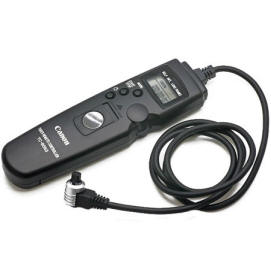
Canon TC-80N3 Remote Control
An essential accessory in my opinion if you own a Canon DSLR. I own two, one for the 20D and the other for the 350D; necessary because the plug configurations are different for these two cameras and because I often use both cameras simultaneously during astrophotography sessions.
There are less expensive options but this controller is more than just a simple remote shutter release as it allows a degree of programming for number of exposures to take, duration of exposure and delay between exposures.
This ability to act as a shutter intervalometer is a great feature for astrophotography as well as for many daylight shot setups. Some examples where this feature was used can be found in the daylight specialty galleries of this site.
In addition I have a cable for the 350D that allows a laptop computer to control the shutter for long exposures through a serial port during astrophotography sessions.
|
|
|
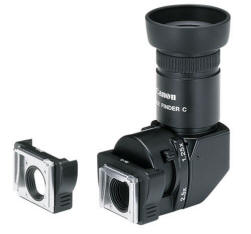
Canon AngleFinder C
I added this accessory to my kit primarily for astrophotography when the camera is mounted on a telescope. This invariably means the viewfinder is in a position where you need to be an accomplished gymnast to be able to see through it. I don't qualify.
Such contortions are not necessary with this accessory. This fits over the viewfinder nicely and swivels to any angle required with detents every 45 degrees. This makes it easy to rough focus and frame a shot in virtually any orientation.
I find I use this accessory quite a bit when working off of a tripod for daylight work as well. This allows me to keep the tripod a bit shorter and more stable while easily viewing through the finder to frame the shot and the swivel capability makes it easy to use for both landscape and portrait orientations. This is a nice accessory to have for that purpose alone.
It also allows a switch between 1.25X and 2.5X power. I find I don't use this feature much and the powers are not par focal but it doesn't hurt to have the capability. Just not terribly useful for my applications.
Downside, the finder easily loses focus. It would be nice if the focus ring could be locked down to prevent this. However, it's a simple matter to refocus before each use and it stays in focus for a typical session. Focusing on the viewfinder information below the image is the best way I've found to do this especially during astrophotography sessions when the image in the viewfinder itself is quite dim. |
|
| Telescopes and Associated Equipment Top of Page | |
|
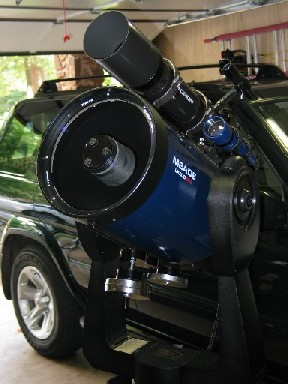
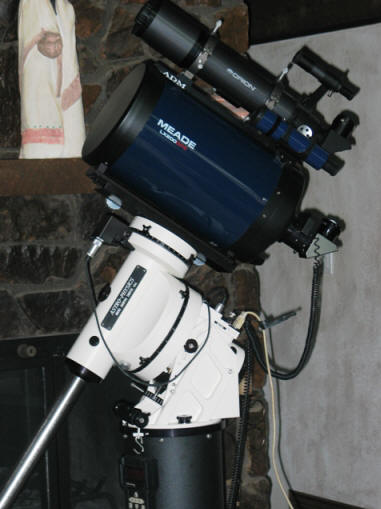
Meade LX200 GPS 10" UHTC
Focal Length: 2,500mm Focal Ratio: f/10
Shown here learning how to be ridden piggy back by an APO refractor in my garage. It bucked a little at first but now doesn't mind a rider.
This Meade was supercharged by Dr. Clay Sherrod of the Arkansas Sky Observatory and the performance is MUCH better after his services. GOTOs especially are much more accurate.
Tracking on the other hand... I really wish Meade would offer a precision drive option for these scopes. PE is quite large on this scope out to about 25 arc seconds peak-to-peak. PEC will reduce this down to about 8 or 9 arc seconds but there are still some jolts in the curve that PEC can't compensate for at the cost of losing frames from time to time.
I bought this scope at Astronomics in Norman, Oklahoma. They are a great bunch of people and their service is first rate. Not to mention that they're right down the road from home! |
|
|
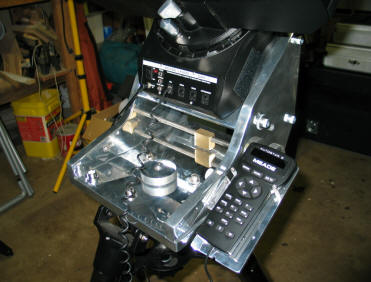
Milburn Equatorial Wedge Bonny Lakes Astroworks - Ken Milburn This is a very stable and easy to use wedge. It's completely machined from aluminum plate so the joints are very tight. I've experienced no vibration problems at all with this wedge and can very highly recommend it. I might choose the anodized version over the unfinished version if I were to do this again. The reflective surface sometimes makes it difficult to see the bubble level when setting up in the dark. |
|
|
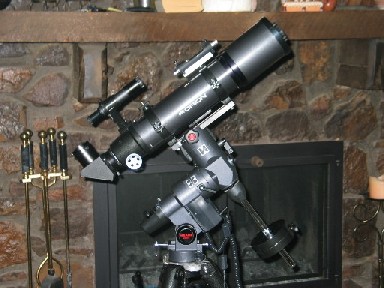
Orion ED 80 Apochromatic Refractor
Focal Length: 600 mm Focal Ratio: f/7.5
Shown hear mounted on a Meade LXD55 mount with the Autostar 497 controller. For the price I can't see how anyone could go wrong with this telescope. The optics are great for a sub $1,000 tube. I've seen no chromatic aberration and the critter will take all the magnification I can throw at it including good planetary observing with a 4X PowerMate.
Going the other way, I've had no problems at all reducing the focal ratio to f/4.7 with a Meade f/6.3 focal reducer. Not an astrograph but pretty fast.
Others have reported problems with the Crayford focuser but this seems to be luck of the draw. I've experienced no problems with slippage at all and the focuser is precise and buttery smooth.
The LXD55 mount is a refurbished mount from Meade's factory outlet. It needed a titch of work when it arrived but it's working well now. |
|
|
The tripod that came with the LXD55 mount is one of Meade's split leg aluminum tripods. If you've ever been around one, you know that they leave little to be desired when it comes to stability and are just not adequate for astrophotography.
I purchased my Orion with the SVP dual track mount (a fine visual only mount in its own right by the way) and the steel leg SVP tripod which is much more stable than Meade's offering.
Unfortunately the azimuth tooth is about a quarter inch longer on the SVP tripod than on the Meade tripod and the LXD55 mount would not quite fit on the tripod.
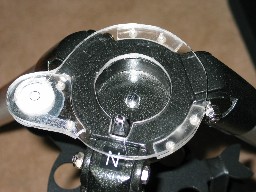
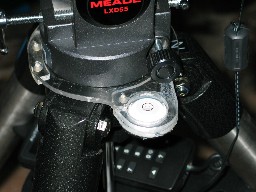
So I built a spacer out of some acrylic I had leftover from another project. This to raise the mount the required distance to work with the SVP tripod. While I was at it, I built the spacer to hold a bubble level for leveling the tripod during setup. Works great! |
|
|
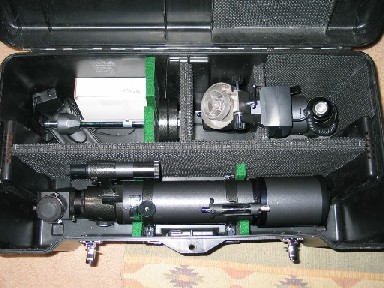
One other shortcoming with the Orion scope offerings is the lack of a nice case for the 80ED to live in. I believe these are available now but they are a bit pricey and don't hold all of the equipment needed for a grab-and-go astronomical outing.
So, I went to the local Wal-Mart and picked up a plastic case then partitioned it off using 1x12 pine to hold all of the equipment necessary for the scope and mount. Eyepieces, camera equipment and the tripod all are packed separately although there's certainly room for eyepieces and camera in this case.
The 1x12 pine was covered with non-skid workbench material and adhesive backed felt both purchased at Home Depot and the cradles for the mount, scope and weight rod hold everything securely and safely.
I wouldn't put this on a plane but this makes for a nice little travel case for the Orion ED and mount for road trips. |
|
|
AP-1200 GTO Equatorial Mount As an acquaintance put it, "If Losmandy is the Cadillac of mounts, Astro-Physics mounts have to be the Mercedes." That sentiment certainly matches my impressions. This mount appears to me to be a Swiss watch on heavy-duty steroids! The attention to detail in every respect is just amazing.
I've been on the waiting list for a new AP-1200 or AP-900 for quite some time now and that can be a 2 to 3 year wait which speaks volumes to the quality of and demand for these mounts.
This one is used but with all of the latest upgrades and whistles including the GTOCP3 controller. Plus, the previous owner took exceptional care of this mount. In other words it's effectively a new mount. The periodic error in right ascension is about 2.5 arc seconds peak to peak which is just outstanding.
I pulled the SCT tube out of the LX200 forks for a first use but will eventually upgrade the tube to perhaps an LX200R and longer term a true Ritchey-Chrétien. This will allow me to put the SCT back in its forks to use as a visual scope or secondary imaging rig.
In the meantime, this mount handles the weight of the SCT and the refractor piggyback with no problems and allows for unguided exposures of 3 minutes and guided exposures to the limits of camera noise and sky conditions at f/10 through the SCT. |
|
| Astronomical Cameras Top of Page | |
|
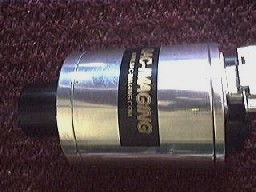
Meade LPI Lunar and Planetary Imager
Shown here mounted to the Meade Microfocuser. This was my first digital astronomical camera and for the $150 price including software it does a remarkably good job for its intended use. This camera is shipping as standard equipment with most of Meade's scopes now.
This camera features a 640 x 480 color CMOS chip and is basically a web cam on steroids although it does not save AVI files. Either individual JPG files are stored or the images are graded, stacked and accumulated by the software and then saved as a single image. The downside is that the maximum exposure the drivers allow is 16 seconds and CMOS chips are not as sensitive as CCD chips making it unsuitable for deep sky work. Nevertheless, most of my lunar and planetary work to date has been done with this camera.
It's another one of those for the price you can't lose things and is a nice way for the novice to enter into astrophotography. |
|
|
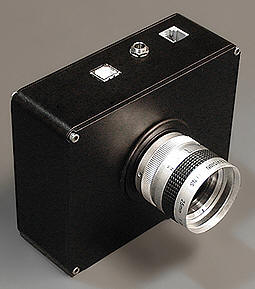
SAC 8-II CCD Camera
This is a relatively inexpensive 640x480 black and white CCD camera also specifically for astronomical photography.
I've been pleased with this camera although the installation of the drivers and use of the software can be a bit of a challenge. Regardless, again, for the price, it's quite a bargain for what it can do and makes for a fine beginning monochrome deep sky imager. There are however other and probably better options available now so shop around and do some research.
I've since retired this imager and most likely will be selling it.
|
|
|
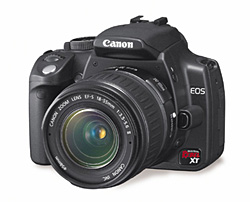
Hutech Modified Canon 350D (Rebel XT) This is my primary deep sky astrophotography camera. I selected the "Type I" filter for this camera and my purchase was the body only. The Type I filter provides vastly improved sensitivity to the extremely important Hydrogen Alpha frequency of light present in emission nebulae with sharp cutoffs at the UV and NIR frequencies. I use this camera as a dedicated astronomical camera as the Type I filter causes daylight shots to be much too red in color. This can be almost completely eliminated with a custom white balance simply done by shooting an image of a white sheet of paper or a neutral gray card in sunlight and using that image to set the custom white balance in the camera. Shooting a white sheet of paper results in a slightly green balance that is easily rebalanced after the fact. With an 18% gray card, the color balance is restored to a level that I'd be satisfied with for daylight photography. The only downside is that the custom white balance will not be used for any of the auto modes. Even this limitation is not a problem for me as I almost always shoot in aperture priority anyway. One can also purchase filters to restore the normal color balance and double up on the use of this camera. I have no need for that since I have the 20D for daylight. But I have set a custom balance using a gray card to better balance my astrophotography shots. I chose the 350D over the 300D (Rebel) for the higher resolution of 8 mega pixels versus 6 and USB 2 transfer speeds. The latter is critical when shooting raw frames direct to a computer. The higher resolution means smaller pixels given the APS chip size which also means this camera is not quite as sensitive but cropping and scaling astronomical images is often necessary with these comparatively big chips. Having the extra resolution is important for that. As an aside, the purchase of this camera has allowed me to evaluate the Rebel style body and I'm pleased to say that my choice of the 20D for daylight work was the right one. While I have no complaints regarding this camera for astro work I would not have been satisfied with it or the Rebel for daylight work. The body doesn't fit my hand well. The right hand grip feels too small to me and overall it feels delicate. Also the controls are not as intuitive or as accessible as with my 20D. I'm picky when it comes to cameras and the Rebel is and feels like a big step down from the 20D. Of course it's also much less expensive than the 20D so trade-offs are inevitable. Regardless the Rebs can certainly shoot some fine pics. For those wishing to enter into the DSLR world on a budget, the Rebel XT is a fine choice. |
|
|
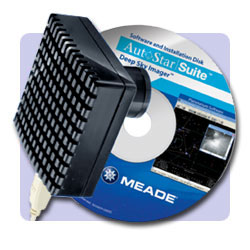
Meade Deep Sky Imager I bought the DSI-C (color version) strictly for a guide camera while imaging through my Canon equipment and haven't really done much imaging with it. While there are people doing nice work with DSI, the most common comment I hear from those I know that use one for imaging is, "I've got to get a higher resolution camera!" I find images even from the DSI experts to be a bit soft and bloaty due to this lack of resolution. Still, for the price, this makes a nice entry level camera for deep sky astrophotography and I'd probably go this way or possibly with the DSI-Pro monochrome version over other offerings. But there are many entry level cameras available now. As far as guiding goes, this appears to be hit and miss. Some apparently never have problems. Me, I ALWAYS had problems at least with the LX200 mount and I think due to serial communications latency. I'll most likely end up selling this camera. It just didn't cut the mustard for my intended use. |
|
|
SBIG ST-402ME
I acquired this camera as a guide camera replacement for the DSI and, of course, SBIG is the recognized leader hands down for astronomical cameras.
I did have a problem with this camera though. The shutter stopped working while at Okie-Tex 2005. It turns out the color filter wheel had been assembled upside down. SBIG was kind enough to put a standard shutter in and sent me back the filter wheel all at no charge as a warranty repair. Great service and the camera has been fine ever since.
As far as guiding, MUCH improved over the DSI. As I said, I suspect the problem with the DSI is latency in the serial communications. Since the 402 has an autoguider port, that latency is nicely bypassed. I've not done any serious imaging as yet with this camera but I'm sure it will do very well with great sensitivity and resolution even though the chip is on the small side. Regardless, for an autoguider, just do it! It's a nice replacement for the STV and ST-4 with a more sensitive and larger chip. |
|
|
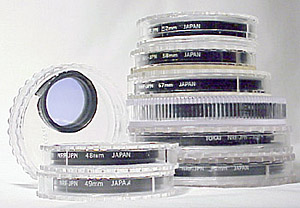
Astrophotography Filters
IDAS LPS This filter is a light pollution suppression filter and comes highly recommended. I'll add my positive recommendation as well. This filter roughly doubles my deep sky exposure times while shooting from the city with essentially no color shifting. While pricey (I have the 2" version) the filter is worth the extra cost in my opinion.
Astronomik 13nm Hydrogen Alpha (Ha) This filter is a new acquisition as of this writing. I intended to use it with the ST-402 for shooting Ha detail to be composited with images obtained with the 350D.
It's been out only once and I actually imaged using the 350D rather than the SBIG. I was pleasantly surprised by the sensitivity of the 350D with this filter despite the Bayer array on the chip and am rethinking my original plans. The small chip on the 402 will require a lot of mosaic construction to include Ha data with the 350 so shooting direct with the 350 would be a huge advantage. More experimentation required.
Astrodon Tru-Balance LRGB Filter Set These filters are used with either the SBIG or the SAC-8 for color composites. The advantage of these filters over other LRGB filters is that they are balanced and par focal so that the exposure times and focus are the same for all frames. Most other filter sets have to be biased with longer blue and green exposures since CCDs tend to be more sensitive in the red spectrum. |
|
|
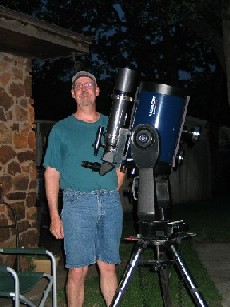
Me!
The essential piece of equipment required for everything else to work although it could probably use an upgrade. Here I am getting setup to do some planetary imaging from my driveway. I live in a bit of a forest and have a narrow patch of sky from north to south right overhead where I can shoot. There is no suitable place for an observatory so my setup is portable. |
|
| Maintenance Tips Top of Page | |
|
Cleaning Optics
Mostly I don't. Telescopes and lenses can both be quite dusty without seriously degrading the image as long as the dust particles are well away from the focal plane of the camera. When I do clean them it's an exercise in paranoia. I first blow off everything that I can using dry air (I do this only when I'm doing a serious cleaning) and then follow up with very careful brushing with a lens brush and then with lots of "Pec Pads" and a good optical cleaner for any stubborn spots. But, as I said, mostly I don't. I clean my telescope glass and filters maybe once every couple of years and camera lenses even less often.
I also as a matter of course purchase an inexpensive skylight filter for every lens more to act as a clear lens cap protecting the front element of the lens than for the benefit of the filter optics. It's much less expensive to replace a filter than a lens in the event of damage and basically eliminates the need to clean the front element of the lens. Of course I also keep standard lens caps over these filters when the lens is not in use.
Camera chips are different. With film, we had the advantage of every frame being shot on a nice clean film emulsion. That's not the case with a camera chip and their electrical charge tends to attract dust. Further, because that dust sits virtually right on the focal plane, it really shows up in all types of images and especially in astro images. Obviously I keep caps on whenever possible but, when using them with a telescope, there's a big dust filled cavity sitting right over the chip and the shutter is open for long times allowing that dust to settle on the chip.
So I clean camera chips every month or so or actually just when I know I'm going out shooting, most especially if that shooting is astro work. But here again this is an exercise in paranoia, first blowing out the big dust bunnies then using Eclipse fluid and a Pec pad for the stubborn stuff and only if necessary. I use a kit from Copper Hills that works very well. Click here for a detailed tutorial on this method and to purchase the kit. I've found it works very well but be careful! You do this at your own risk and can do serious damage to your sensor if you're not extremely careful. |
|
|
Improving Tracking and Guiding of Telescope Mounts
I've done quite a bit of work on both my LX-200 and my LXD-55 mounts to get the best performance that I can out of them. Even so, these are not precision mounts and they still have quite a bit of periodic error that makes long exposure imaging with them a challenge. For the LX-200, the best thing I did was have the scope supercharged by Clay Sherrod. Other than that, it's been a matter of keeping the R.A. worm clean and well lubricated and getting the most out of the PEC training available on the mount. I use a software called PEMPro for that and it's worth the small investment if your mount is supported. That plus some active guiding produces reasonable results for a mount of this caliber and at shorter focal lengths but it can't handle the longer focal length of the SCTs as the periodic error is to irregular to guide or correct out.
I completely overhauled the LXD mount removing all of the nasty black grease and replacing it with quality white lithium grease. I also polished all mating components. This helped this drive out a lot but the worms on this mount leave little to be desired and PE is quite large. I have considered having a couple of high precision worms custom manufactured for this mount and may do it yet. I'm curious about what the results would be. But the majority of imaging I do is done with the AP-1200 so this would be mostly an exercise to assuage my curiosity. For visual and wide field work the tracking is fine on this mount and that's mostly what I use it for. |
|
Last Updated: 11/12/2014 - Copyright © 2004-2013 by Dan Lessmann. All rights reserved. Please click here for my usage policy.
Last Updated: 04/29/2021 - Copyright © 2004-2013 by Dan Lessmann. All rights reserved. Please click here for my usage policy.
|
Last Updated: 04/29/2021 - Copyright © 2004-2013 by Dan Lessmann. All rights reserved. Please click here for my usage policy. |