|
Catching Light Photography by Dan Lessmann |
Oklahoma City Clear Sky Clock
Cheddar Ranch Observatory Clear Sky Clock |


|
|
|
|
|
M42, The Great Orion Nebula
Click images for larger versions. Place mouse pointer over left image for annotations (requires Java).
A much more shall we say artistic version can be found here.
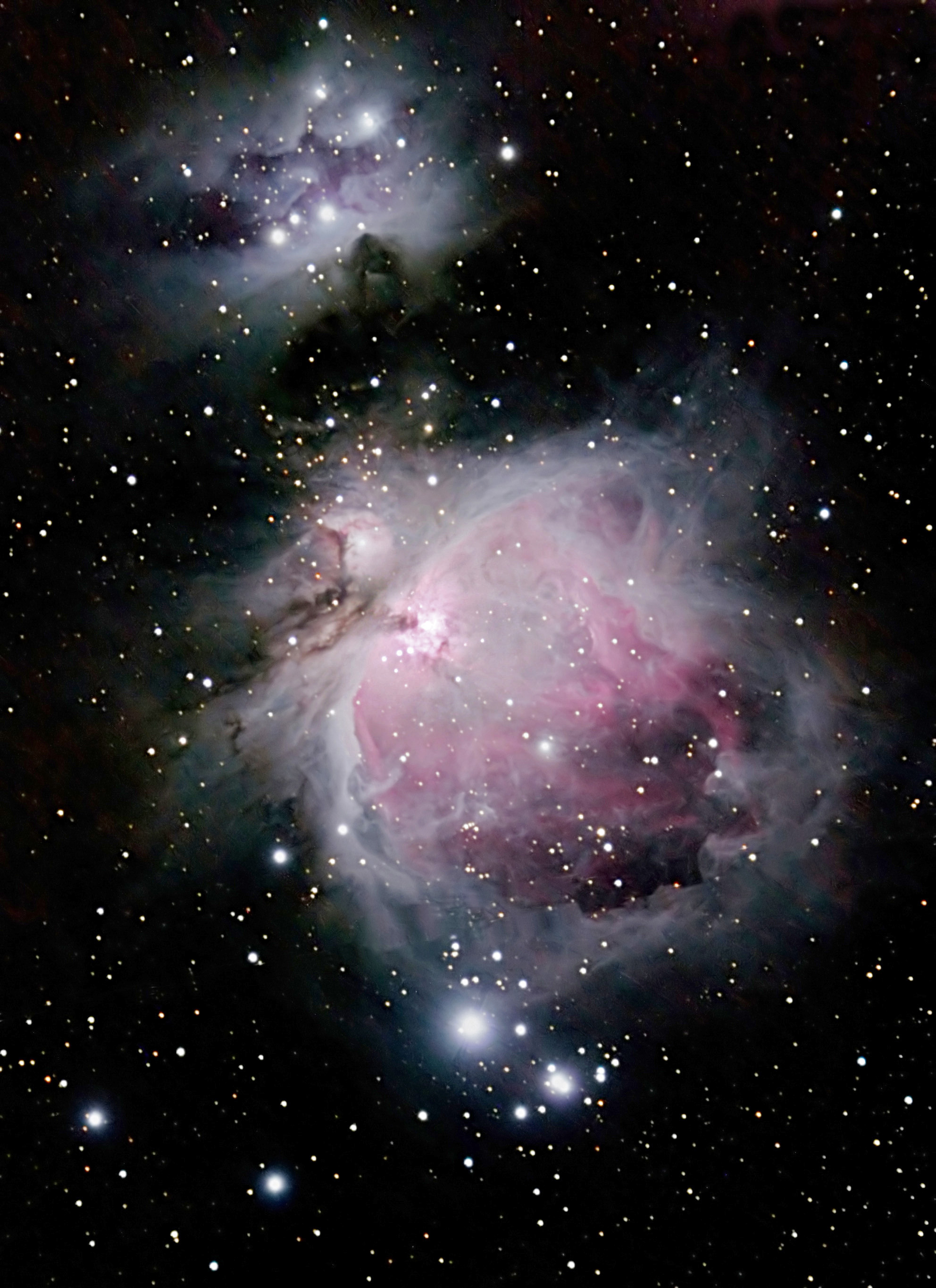
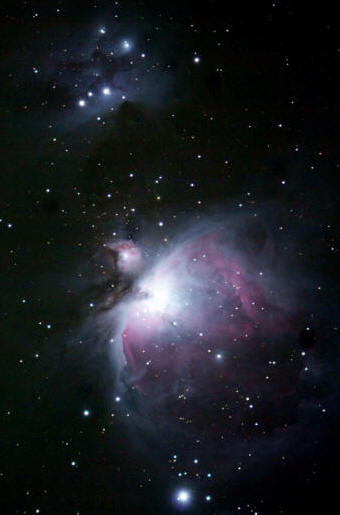
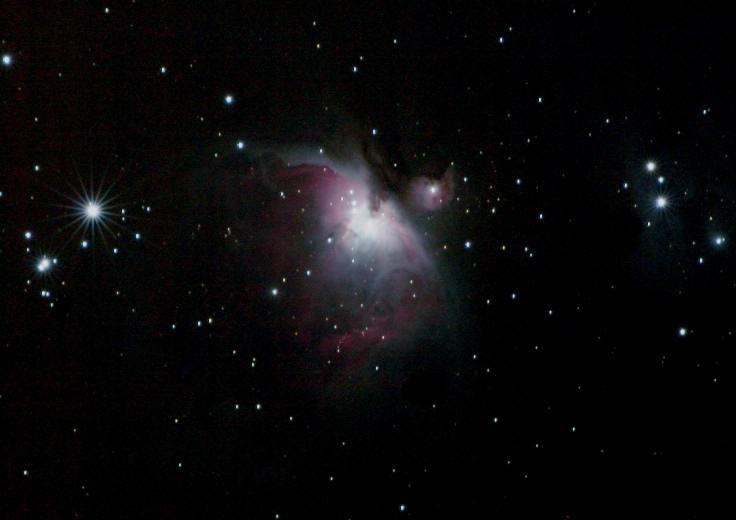
This region is in the constellation Orion in the lower end of his sword. M42, the primary nebula, is about 1,600 light years distant. It is a diffuse nebula with characteristics of both emission and reflection nebulosity and is a region of active star birth. The gas and dust clouds visible in this image are a very small part of a much larger cloud called Orion B that extends up to Orion's belt and well beyond. In addition to M42, M43, de Marian's Nebula is visible here as the upside down comma shaped region above the main nebula. The main nebula is the second "star" up from the tip of Orion's sword.
Above that is the open cluster NGC 1977. In long exposure photography this open cluster displays reflection nebulosity and is commonly called "The Running Man" for the distinct dark dust lanes present in the nebulosity. This is the third "star" up from the tip of the sword.
The bright star below the main nebula is Nair Al Saif and is itself, along with the gas and dust around it, classified as the diffuse nebula, NGC 1980. This 2.75 magnitude blue giant star is 24 times larger than our sun and a double star. It is the tip of Orion's sword.
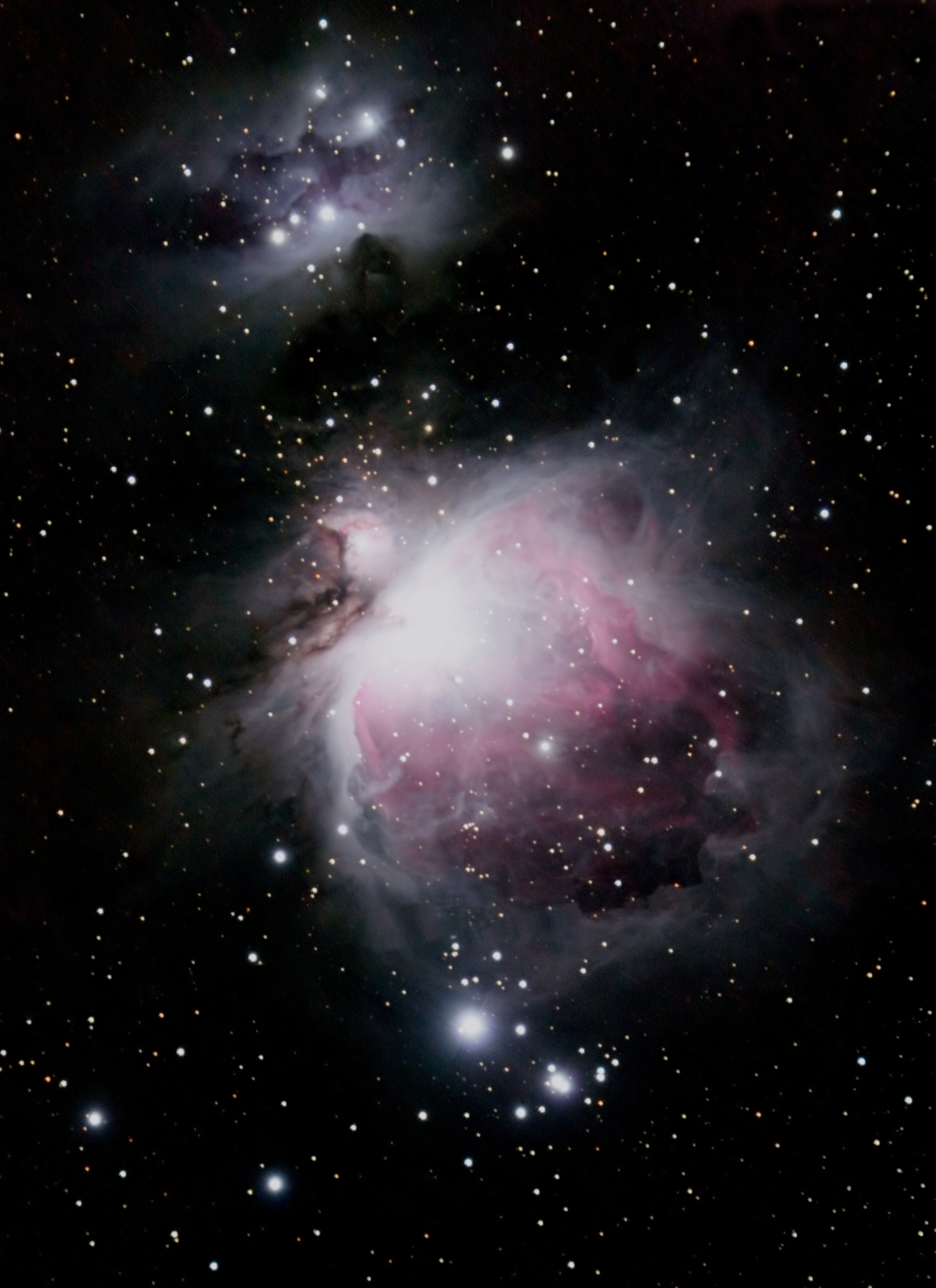
Two versions of the main nebula are shown here. The top right version shows the relative brightness of the various parts of the main nebula. The core is centered around the Trapezium, a cluster of four massive, very hot and young stars born from this cloud of dust and gas along with two smaller companions. The Trapezium is the source of energy for the emission nebulosity of this object. The region around the Trapezium is much brighter than the outlying shells of gas which makes M42 the best of nebula targets for visual observers.
The left, full frame image is a masked image using Photoshop to show the inner details of the core region. Click Here for the techniques used to mask this image. Two masks of the core region were used. Each is shown below the upper right image and each was used to mask the burned out core of the original image in succession. The larger mask on the left was used to mask the original image to bring out the outer core, and the smaller on the right masked the larger mask to bring out the details of the inner core. The second mask is the same image as the first mask with a levels reduction to avoid burning out the Trapezium region.
After masking additional processing using curves and levels layers was done to enhance the contrast.
Date: 10/7/2005 Location: Okie-Tex Star Party, Kenton, OK Telescope: Orion 80ED @ f/7.5 Camera: Canon 20D, ISO 800 Exposure Count: 18 frames @ 3 minutes, total exposure 54 minutes Core Masks: 3 frames @ 20 seconds, 5 frames at 10 seconds using Hutech Type I 350D, 1/28/06, American Horse Lake. Guiding: Unguided Acquisition and Focus: DSLR Focus Post Processing: Images Plus, Photoshop, Neat Image
| ||
|
Previous Attempts
12/11/2004
12/2/2004
|