|
Catching Light Photography by Dan Lessmann |
Oklahoma City Clear Sky Clock
Cheddar Ranch Observatory Clear Sky Clock |






|
|
|
|
|
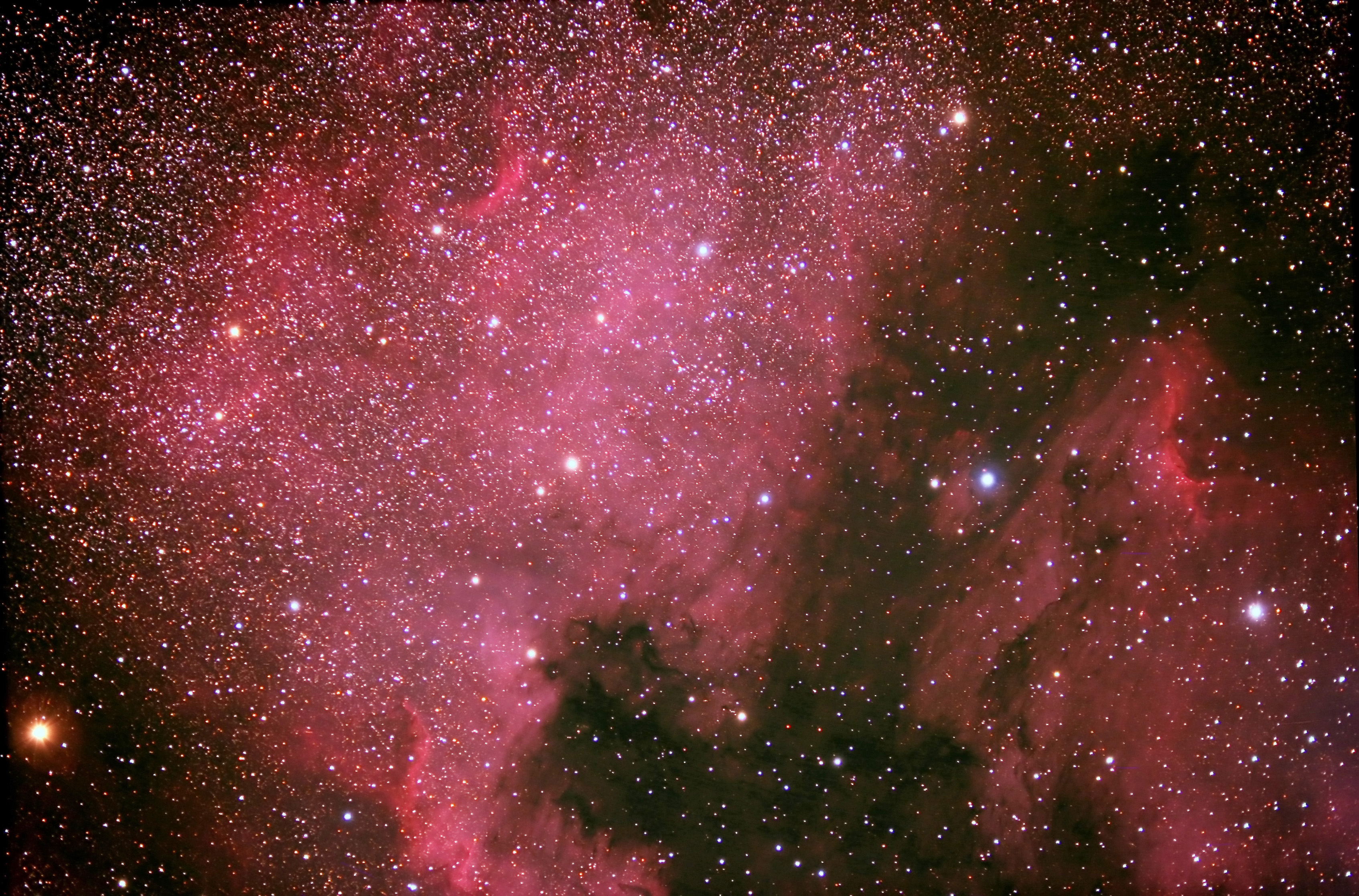
NGC 7000, The North American Nebula
Click image for a larger version.
|
|
The nebula on the left in this image is NGC7000, the North American Nebula. It's obvious why it is named as it is. To the right is the Pelican Nebula, IC5070. Both nebulae are emission nebulae in the constellation Cygnus about three degrees east of Deneb at about 1,600 light years distance.
Emission nebulae primarily consist of hydrogen gas that is raised to a higher energy state (the single electron is pushed to a higher orbital) by radiation from the surrounding stars. When the electron falls back to a lower energy state, the atom typically emits a photon of light at the hydrogen alpha (Ha) frequency of 656.3 nm. This frequency is in the red end of the visible light spectrum and gives an emission nebula its distinctive red color.
Nebulae of this type are typically regions of active star birth and these two nebulae are no exception. Higher resolution images of this region reveal massive, light years long, pillars of dust and gas from which stars are being born.
Date: 9/30/2005 Location: Okie-Tex Star Party, Kenton, OK Telescope: Orion 80ED @ f/4.8 (Meade f/6.3 reducer) Camera: Hutech Type I Modified Canon 350XT, ISO 800 Exposure Count: 28 frames @ 3 minutes, total exposure 1.4 hours Guiding: SBIG ST402, CCDSoft on 10" LX200GPS Post Processing: Images Plus, Photoshop |
Last Updated: 11/12/2014 - Copyright © 2004-2013 by Dan Lessmann. All rights reserved. Please click here for my usage policy.
|
Last Updated: 04/29/2021 - Copyright © 2004-2013 by Dan Lessmann. All rights reserved. Please click here for my usage policy. |